

Introduction
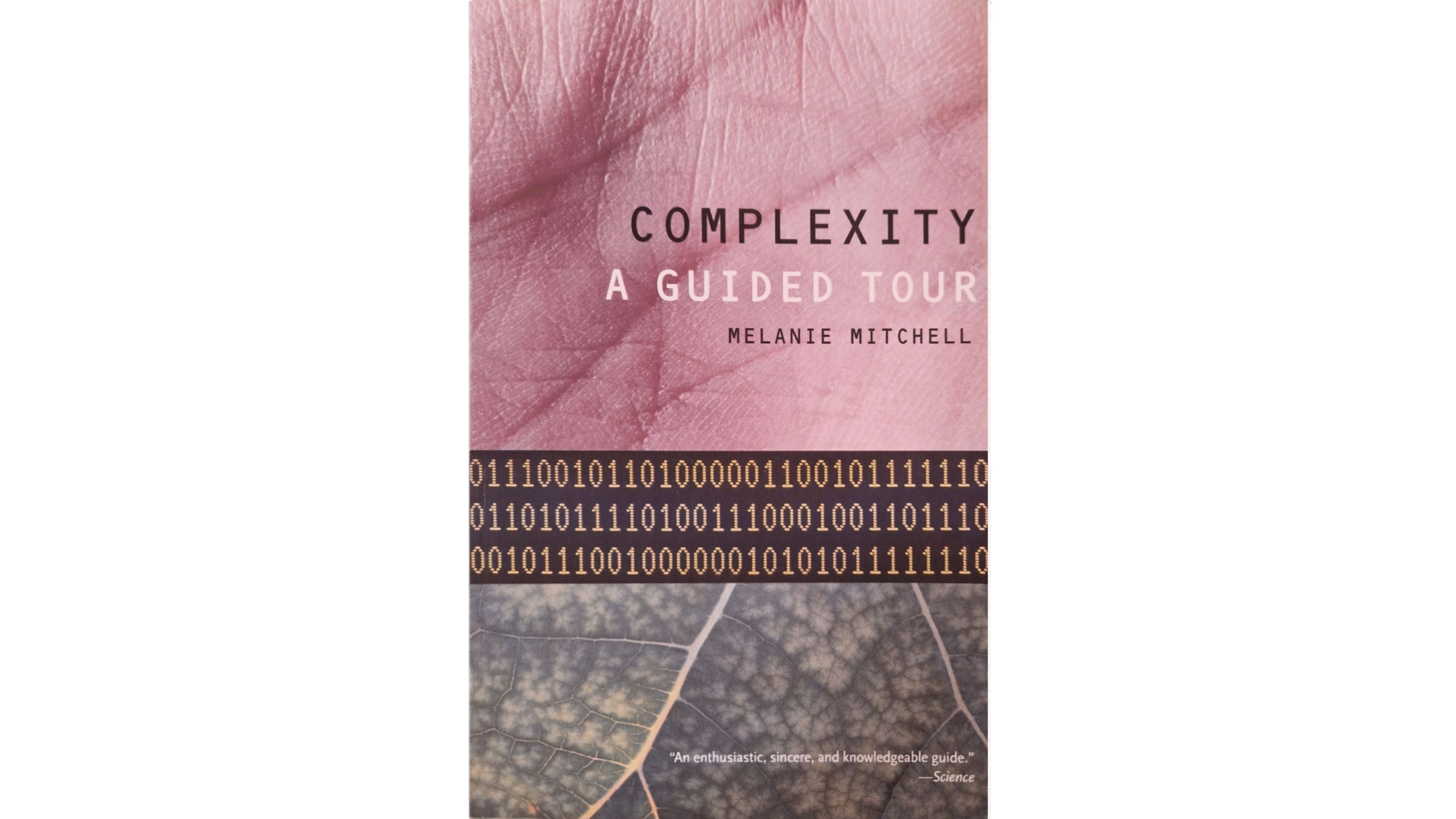
The intention with “Complexity – A Guided Tour” is to give an introduction to and an overview of the general field of complexity science, a field in which common characteristics and principles for complex systems are researched.
The target audience is a general, curious reader with no specific background. Personally, I found it relatively easy to read and follow the text, but I benefitted from my background in mathematics and computer science. The text is almost free from math, but the thinking which comes from an education in mathematics or computer science is an advantage.
Content
After giving some examples on what constitutes complex systems, Mitchell introduces relevant topics for understanding complexity and provides background and history. The topics include dynamic systems, chaos, information, and computation. Different views on what complexity is and how it can be measure are presented.
Computation is a key concept throughout the book. First, computation is a means to model systems of interest to gain understanding and improve intuition about complexity. Second, it is also a fundamental concept which is relevant to the behaviour of the complex systems which are explored. The information processing which takes place in an ant colony, for instance, can be viewed as a kind of computation going on within the system defined by the colony.
The examples used in the book are from biology (e.g. ant colonies, the brain, the immune system, evolution, genetics), economies, social networks, and the internet
An entire section is devoted to networks and general ideas related to networks. This part highlights how complexity arise from interactions between elements in a set, and the fact that these interactions are a bigger driver of complexity than the size of the set itself.
Even though the book was written many years ago, it does not feel outdated. Of course, major progress will have been made since 2009 within the field, but this would not invalidate the content, I think. But I am curious to know, whether any major breakthroughs have been made, especially in the general question on how to define “complexity” and “complexity sciences”
In the closing chapter, Mitchell concludes that the entire field (at the time of writing) is still not well defined, and the field seems to be “a fragmented subject rather than a unified whole”.
Application to Supply Chain Management
There is no doubt that supply chains are complex systems in the sense of the book, and I am sure that there are applications to supply chain management. However, the connections are not so obvious that general complexity theory seems really use ful at this time. It would be interesting to know if there were more specific work linking results from complexity to supply chains e.g., modelling supply chains as networks is an obvious idea.
Style
Mitchell mixes presentation of facts with her own perspectives and experiences in a pleasant way. Adding anecdotes and references to other parts of science, in particular physics, help put the topic into context. Mitchell attempts to balance different views and present both the various theories and their criticism. In general, the book has a sober tone, which I like.
Conclusion
“Complexity – A Guided Tour” is a good introduction if one wants a broad overview of the field of “Complexity”. It is of course a bit annoying that no clear definition of “Complexity” is given, but that is not the fault of the author or the book. In fact, having read the book, I appreciate how complex the field of complexity is. The book has given me a good overview of the topic and the problems which are of interest within the field.
In conclusion, I really enjoyed the book. Only in a few places, I think the level of detail was too much. This takes away half a point from a book which I found met its purpose, overlapping nicely with my purpose for reading it.
Rating: 4½ out of 5